
2019 August – Taccle 3 Course in Milan
Report
Report on Taccle 3 course (19th to 23rd August)
As part of our Erasmus project “Numeracy and Literacy through Coding and Robotics”, all partners from Malta, Italy, Portugal and Slovenia attended a course in Milan. The course focused on training teachers understand computational thinking and coding so as they, in turn, would be able to introduce computational thinking and programming in primary schools and teach children how to code. The training has been designed by the Taccle 3 project partners and our training coaches were Annemie and Christel from Belgium.
We started off with the coaches outlining the programme and asking us to jot down our expectations from the course so that we could go back to our list at the end of the course and evaluate on the results. Ice-breaking exercises followed throughout the first morning which allowed us to get to know each other better, especially since we were to work with each other throughout the following days.
Following the ice breaking exercises, we gathered in our meeting room and focused on computational thinking, its meaning and how it differs from coding and programming. Over the next couple of days, in fact we had different workshops where we had to work in groups on different exercises that we as educators could give to our students and which focused on the different elements of computational thinking (decomposition, pattern recognition, abstraction, algorithmic thinking, logic and evaluation). Since each group consisted of persons from different countries, we were able to share experiences of similar activities carried out in our countries which, in turn enabled us to gather more ideas for future implementation in our respective schools. We also discussed variations to each activity and what we could alter to meet the different needs and abilities of all students that we have in our schools.
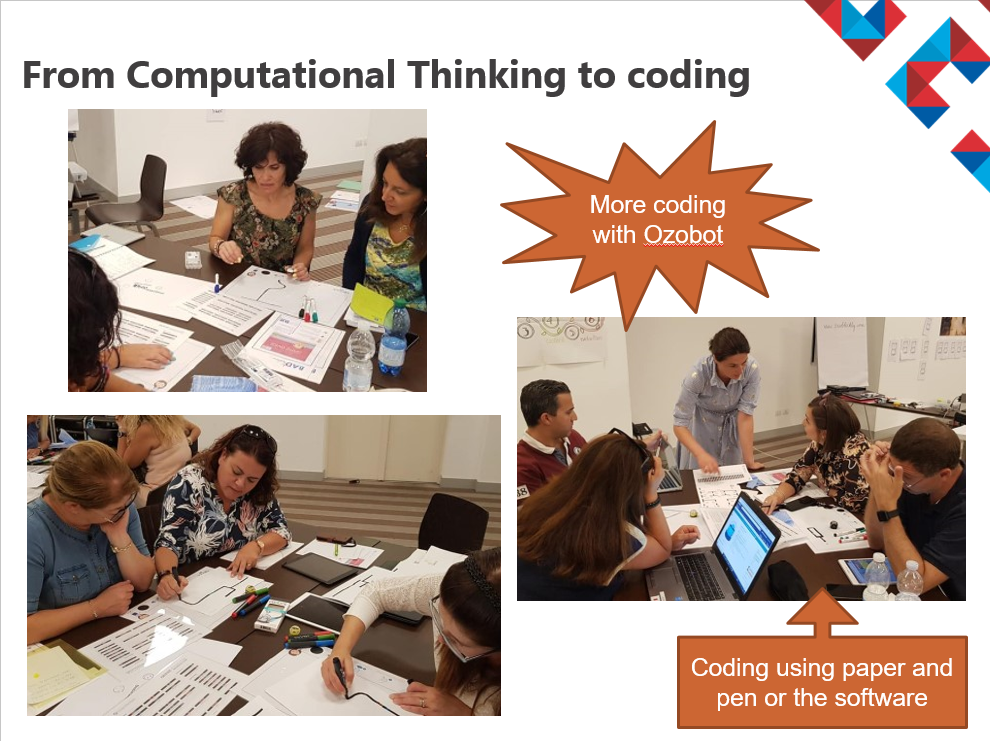
Once we were confident of our understanding of computational thinking, Christel and Annemie moved on to show us a selection of different programmes and robots that we could use with our students. During the next couple of days we learnt how to work on Scratch, Scratch Jr, Ozobot, Dash and Dot and Microbit. We were given the opportunity to come up with our own programmes and try out each robot and design activities that we could do in our classrooms with them. We also watched different videos of children from other countries working on the different robots which also helped us evaluate the impact of robotics on the students.
Finally we had to work on developing activities showcasing what we learnt about computational thinking that we could adapt and use with our students in the classrooms. Our last day was in fact dedicated to presentations with each country presenting different activities related to both the unplugged part of computational thinking as well as to activities that involved the use of robotics. Each activity required other participants to take active part in the activities and thus experience what the students would actually feel like, giving us a clearer picture of impact and effects these elements have.
As a concluding activity we had to refer to our initial aspects on the course and reflect on what we have learnt and if our expectations were met. Needless to say we were all satisfied and all felt empowered with the necessary skills to now implement our knowledge in our respective schools.
Finally, the main representatives of each country participating in the Erasmus project, met and discussed the way forward. We discussed what the next steps will be, how we will disseminate our new found knowledge in our schools and how we are to share our experiences with each other through different media such as the Mobility tool, Google Docs and the dedicated website. We also discussed the next Mobility which will be held in November in Portugal and preparations needed for the event. We all look forward to the rest of our project and eager to keep sharing practices which will help us become better educators and have better schools for our students.