
2019 November – Mobility in Portugal
Report
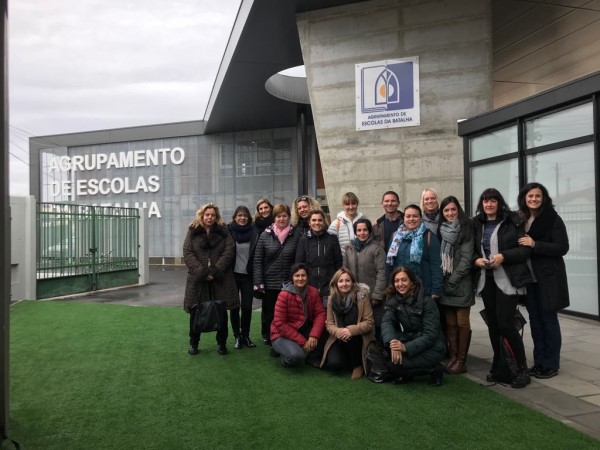
Report on Portugal Mobility – 18th to 21st November 2019 (by Portuguese Participants)
The second mobility of the Erasmus + project “Numeracy and Literacy through Coding and Robotics” took place at Agrupamento de Escolas da Batalha in Portugal, from 18th to 21st November 2019, as previously scheduled with the partner countries.
The Portuguese teachers organized working groups and met every fortnight to organize the logistics, workshops and all the documentation related to this mobility.
All decisions, documents and program were shared with peers from partner schools so that they would be aware of all the steps and decisions taken as well as to get ready for the mobility which was about to happen in Portugal, a great opportunity to share experiences and teaching good practices. Each partner school got a formal invitation to be present in Portugal as well as the program for the upcoming week.
As the main aim of this kind of projects is the possibility of sharing and teaching each other, it was thought that we could provide different workshops in which different computer programs would be used in varied contexts, having as background the themes/ topics of the different curricular areas. Having this in mind, the Computer Science teachers asked their students from 10th, 11th and 12th grades of the Professional Course of Programming Technicians and Computer Systems to promote, manage and conduct workshops on Minecraft, Micro: Bit, Astro Pi, QRCode activities, 3D Print. These workshops enabled the development of teaching, communication and social skills and the improvement of English language proficiency.
Another very important point for this mobility was the possibility of sharing of best practices of projects that had been developed in our primary education classes, activities linked to our global Erasmus project. Thus a moment was scheduled so that teachers could present the projects to the foreigner partners: Para nde vai o plástico (Where does plastic go?), Aprendo @Escolher (Learning to choose), Robots@School (Robots and School). During the presentation of the projects there was peer interaction, students were also involved in the activities that were being carried out.
When planning the activity, we thought there was a need to know more about e-Twinning and as we have an e-Twinning Ambassador in our school we decided to have a workshop on this platform, once it can be a great tool to organize and present the project. Furthermore, e-Twinning can also be a great asset when it comes to dissemination of projects.
Since Agrupamento Escolas da Batalha covers a very large geographical area and some primary school are located in the outskirts of the town, we decided to have guided tours only to those which were located in the centre of our little town. This decision was based on nearness in terms of space and time. This way it was possible to walk to two schools: Escola Básica da Batalha and Escola Básica e Secundária da Batalha.
It was also a concern of this working group to schedule the places for the meals and, whenever possible, the menus were set to enable our foreign guests to taste Portuguese cuisine. The information concerning the cost of the meals and the location of the restaurants was previously shared with our colleagues.
The accommodation suggested to colleagues was “A Casa do Outeiro”, a small hotel located in the centre of our small town. The hotel location allowed teachers to move around without extra expenses. It was also important to provide them with a relaxing and friendly environment.
Cultural activities were scheduled in order to show and enhance the history, religion, culture, natural beauty of our country. It was possible for colleagues to visit: the Monastery Nossa Senhora das Vitória, the nearest city called Leiria, Santuário de Fátima, the Alcobaça Monastery and Nazaré beach. The transportation of the teachers was provided by the local council.
The mobility proceeded according to the plan, it all started on November 17 with a dinner for all the teachers involved, followed by an icebreak activity that allowed the introduction/ presentation and interaction of the host members and foreign partners.
While carrying out the activities, several changes had to be made related to the places where those activities were taking place because one of the teachers revealed problems in walking long distances or climbing stairs therefore we had to adapt to this limitation, and perform the planned activities in alternative rooms.
All material and resources used, shared and produced during the mobility were shared on the project’s eTwinning Space page.
Mobility was posted on the project’s Facebook page, on our school Facebook, and the events were published in local, district and school newspapers.
At the end of the mobility, the certificates were distributed and the link was shared so that participants could assess activities.
As the coordinator of the school in Malta could not be present in Portugal during the mobility, a meeting via skype was scheduled for the following week to coordinate the next activities to be developed and to outline the information for the intermediate report that the coordinating school will have to make by December 1st.
In this mobility it was not possible for Portuguese teachers to be present during the teaching activities since there are few human resources, that is, the school could not replace them in their own classes. Finally, a date will be scheduled for sharing the presentations prepared by the Portuguese students.
By Fernanda Alvega